
Why Is TPRM Important?
Third-party relationships introduce potential risks, including:Cybersecurity threats – Vendors with access to sensitive data can become attack vectors for breaches.Operational disruptions – A supplier failing to deliver critical components can impact business continuity.Regulatory compliance – Organizations must ensure third parties adhere to legal and industry standards.Reputational risks – Poor vendor practices can damage a company’s brand and trustworthiness.
Blog

No Available Content
Publications

CISA: The Journey to Zero Trust
Microsegmentation in Zero Trust Part One: Introduction and Planning
CSA Cyber Threat Psychology WG Abstract
CSA Cyber Threat Psychology WG Session 20250210
CSA Cyber Threat Psychology WG Session 20250224
CSA Cyber Threat Psychology WG Session 20250310
Cyber Threat Psychology Research Group

Department of Defense (DoD) Zero Trust Reference Architecture
The DoD Cybersecurity Reference Architecture (CS RA) documents the Department’s approach to cybersecurity and is being updated to become data centric and infuse ZT principles. ZT supports the 2018 DoD Cyber Strategy, the 2019 DoD Digital Modernization Strategy, the 2021 Executive Order on Improving the Nation’s Cybersecurity, and the DoD Chief Information Officer’s (CIO) vision for creating “a more secure, coordinated, seamless, transparent, and costeffective architecture that transforms data into actionable information and ensures dependable mission execution in the face of a persistent cyber threat.” 2 ZT should be used to re-prioritize and integrate existing DoD capabilities and resources, while maintaining availability and minimizing temporal delays in authentication mechanisms, to address the DoD CIO’s vision
DoD Zero Trust Strategy
This Zero Trust strategy, the first of its kind for the Department, provides the necessary guidance for advancing Zero Trust concept development; gap analysis, requirements development, implementation, execution decision-making, and ultimately procurement and deployment of required ZT capabilities and activities which will have meaningful and measurable cybersecurity impacts upon adversaries. Importantly, this document serves only as a strategy, not a solution architecture. Zero Trust Solution Architectures can and should be designed and guided by the details found within this document.
ESAs publish first list of “Critical ICT Third-Party Providers” under DORA
ISACA Round Table 2025 Oct 07 Cyber Threat Psychology

NSA: Embracing a Zero Trust Security Model
As cybersecurity professionals defend increasingly dispersed and complex enterprise networks from sophisticated cyber threats, embracing a Zero Trust security model and the mindset necessary to deploy and operate a system engineered according to Zero Trust principles can better position them to secure sensitive data, systems, and services.

NSTAC Report
In May 2021, in the aftermath of a series of significant cybersecurity incidents, the White House tasked the President’s National Security Telecommunications Advisory Committee (NSTAC) with conducting a multi-phase study on “Enhancing Internet Resilience in 2021 and Beyond.” The tasking directed NSTAC to focus on three key
Zero Trust Architecture
This publication has been developed by NIST in accordance with its statutory responsibilities under the Federal Information Security Modernization Act (FISMA) of 2014, 44 U.S.C. § 3551 et seq., Public Law (P.L.) 113-283. NIST is responsible for developing information security standards and guidelines, including minimum requirements for federal information systems, but such standards and guidelines shall not apply to national security systems without the express approval of appropriate federal officials exercising policy authority over such systems. This guideline is consistent with the requirements of the Office of Management and Budget (OMB) Circular A-130.
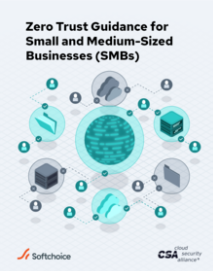
Zero Trust Guidance for Small and Medium Size Businesses (SMBs)
This publication provides guidance for small and medium-sized businesses (SMBs) transitioning to a Zero Trust architecture

Zero Trust Maturity Model
Zero trust provides a collection of concepts and ideas designed to minimize uncertainty in enforcing accurate, least privilege per-request access decisions in information systems and services in the face of a network viewed as compromised. The goal is to prevent unauthorized access to data and services and make access control enforcement as granular as possible. Zero trust presents a shift from a location-centric model to a more data-centric approach for fine-grained security controls between users, systems, data and assets that change over time; for these reasons. This provides the visibility needed to support the development, implementation, enforcement, and evolution of security policies. More fundamentally, zero trust may require a change in an organization’s philosophy and culture around cybersecurity.
Video Resources